Walking into a hardware store as a new woodworker is overwhelming. Hundreds of tools, dozens of brands, and absolutely no idea what you actually need versus what's clever marketing. This guide cuts through the noise, ranked by what to buy first, with honest budget alternatives for every tool.
Reader Note: This article contains affiliate links. If you choose to purchase through one, we may earn a small commission at no extra cost to you. We only recommend products we genuinely stand behind. Full disclosure here.
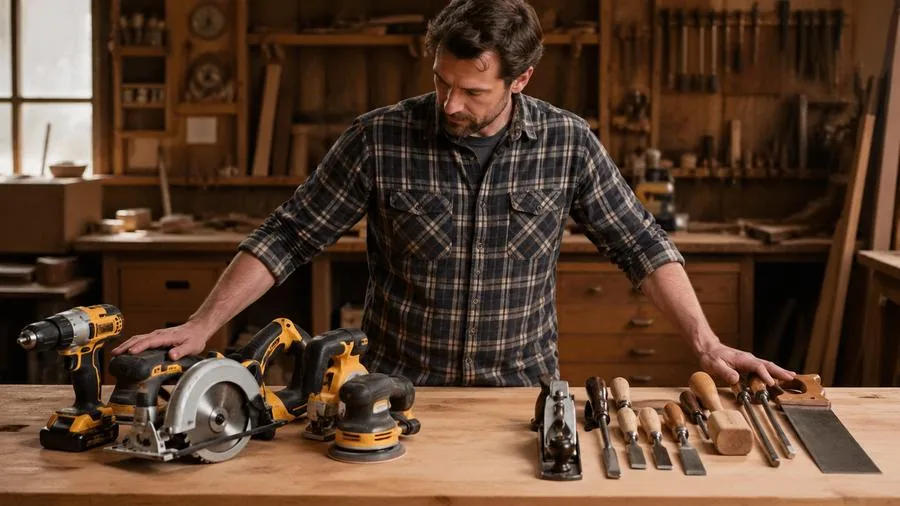
The Golden Rule: Buy Tools as Projects Demand Them
The biggest mistake beginners make is buying a full workshop before starting. Buy tools as specific projects require them. This forces you to learn each tool properly before buying the next, and means every tool you own gets used regularly.
🔧 Get Plans That Tell You Exactly Which Tools You Need
Every plan in our 16,000 plan library includes a complete tools list, so you know before you start exactly what's required for that specific project.
📐 Browse All 16,000 Plans →Tier 1: Buy These First (Every Beginner Needs These)
1. Cordless Drill / Driver
Why first? The single most versatile tool in woodworking. Used for drilling holes, driving screws, mixing finishes, and even light sanding with attachments. Buy an 18V model with two batteries, the second battery is non negotiable; running out of charge mid project is infuriating.
Budget option: Ryobi 18V, reliable and parts are widely available. Mid range: DeWalt 20V MAX. Premium: Festool or Milwaukee.
💡 Tip: Always buy drill bits separately. The bits that come packaged with drills are usually low quality. Spend an extra €20 on a proper HSS bit set.
2. Tape Measure
A good 5m tape measure with a wide, lockable blade. Look for clear markings at 1/16" increments. Stanley FatMax is the benchmark, used by professionals worldwide. Don't cheap out here; a poorly marked tape introduces errors at the source.
3. Carpenter's Square (Speed Square)
Used to check 90° angles and mark cut lines. A plastic speed square works fine to start; a metal one lasts forever. You'll use this on every single project.
4. Hand Saw (or Circular Saw)
For breaking timber down to rough size. A sharp handsaw handles most beginner projects. A circular saw is faster and more accurate for sheet goods, buy one as soon as your budget allows (€60,€120 for a reliable beginner model).
💡 Tip: A blade with more teeth per inch (TPI) gives a smoother cut. Use high TPI blades for finishing cuts, lower TPI for fast rough cuts through structural timber.
5. Random Orbital Sander
The difference between an amateur and professional finish is almost entirely down to sanding. A random orbital sander eliminates the swirl marks that straight line sanders leave. Start with 80 grit, work up to 220 grit. Budget €40,€70 for a solid beginner model.
Tier 2: Add These After Your First Few Projects
6. Jigsaw
For curved cuts, internal cutouts, and more complex shapes. A jigsaw opens up enormous creative possibilities. Budget €50,€100 for a beginner model. Use quality blades, cheap blades wander and break.
7. Miter Saw (Compound)
The single best upgrade for accuracy and speed. A compound miter saw makes perfect crosscuts and angled cuts in seconds. It's a significant investment (€150,€400) but transforms your work quality immediately. This is the tool that makes furniture joints actually fit.
8. Clamps (Lots of Them)
A woodworker's joke: "You can never have too many clamps." Buy at least 4 F clamps and 4 quick release bar clamps to start. You'll use them constantly, for glue ups, holding work while drilling, and assembling joints.
Tier 3: Specialist Tools (When Projects Demand Them)
- Router & Table, for edge profiling and joinery
- Pocket Hole Jig (Kreg), fast, strong, beginner friendly joinery
- Biscuit Joiner, for aligning and strengthening edge joints
- Table Saw, for ripping long straight cuts in sheet goods
- Thickness Planer, for dimensioning rough sawn timber
Safety Equipment, Never Optional
- Safety glasses, every time, no exceptions
- Hearing protection, power tools cause permanent hearing damage over time
- Dust mask (N95 minimum), wood dust is a known carcinogen
- Push sticks, for table saw and router table work
- First aid kit, in your workshop at all times
🌲 Get Plans That Match Your Current Tool Kit
Our 16,000 plan library includes projects for every tool level, from hand tool only beginner projects to full CNC compatible designs. Find exactly what you can build with what you have right now.
📐 Find Projects for My Tools →Affiliate link, we may earn a commission at no extra cost to you.
📂 Related: 10 Easy Beginner Projects · Budget Workshop Setup · Full Workshop Guide