The number one reason people delay starting woodworking isn't lack of interest, it's the belief that a proper workshop costs thousands of dollars. It doesn't. With $500, smart tool selection, and the right layout strategy, you can build a genuinely productive workshop capable of completing real, satisfying projects.
Reader Note: This article contains affiliate links. If you choose to purchase through one, we may earn a small commission at no extra cost to you. We only recommend products we genuinely stand behind. Full disclosure here.
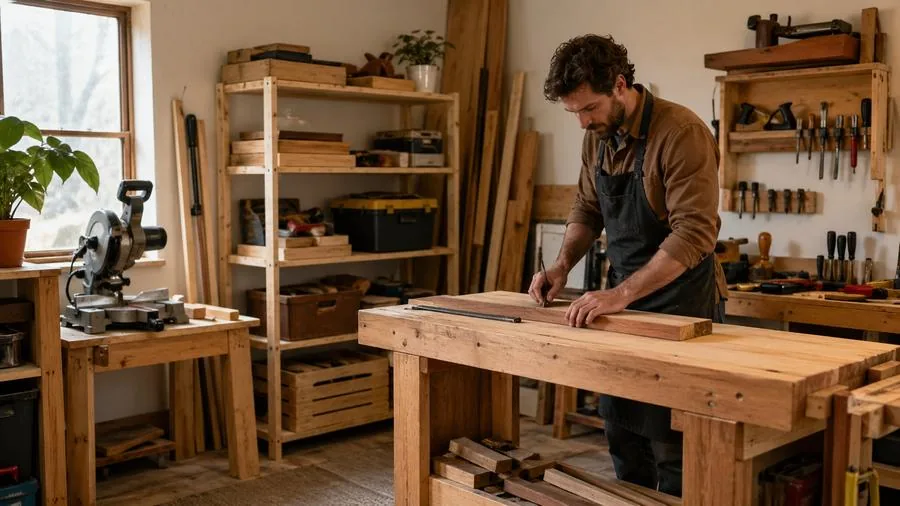
The $500 Budget Workshop Philosophy
The key to a budget workshop is prioritising capability over convenience. A professional workshop has every tool immediately accessible on dedicated storage and costs tens of thousands. A budget workshop achieves 80% of the same capability by being strategic: buying fewer, more versatile tools; using DIY storage solutions; and choosing a compact layout that maximises small space. The goal isn't to build an impressive workshop, it's to build impressive projects.
🔧 Build Your Workshop Right, Starting with the Right Plans
Once your workshop is set up, you need projects to build in it. Ted's Woodworking gives you 16,000 plans organised by skill level, perfect for new workshops with basic tool sets. Start building from day one.
Get 16,000 Woodworking Plans →The $500 Budget Breakdown
Tier 1 Priority: Cutting & Measuring (~$180)
Your first spending priority is a circular saw and a basic measuring kit. A mid range 7¼" circular saw ($80,100) is the single most versatile cutting tool a beginner can own, it handles ripping boards, cross cutting, and sheet goods. Pair it with a good tape measure ($12), a speed square ($10), and a marking gauge ($15). Budget for a quality combination blade ($25) that handles both ripping and cross cutting, this avoids the need for multiple blade types early on.
💡 Buying Tip: Buy your circular saw from a brand that shares batteries across their power tool range (Milwaukee, DeWalt, Makita, Ryobi). Every additional tool you buy from the same system shares batteries, significantly reducing cost as your tool collection grows.
Tier 2 Priority: Drilling & Fastening (~$80)
A cordless drill/driver in the same battery ecosystem as your saw is the next investment. A basic model ($60,80) will handle everything a beginner needs. Buy a drill bit set ($15) that covers common sizes. For fastening, a basic clamp set, four 6" F clamps and two bar clamps ($40 total), is essential for any glue up and for holding work securely while cutting.
Tier 3 Priority: Sanding & Finishing (~$60)
A random orbital sander ($40,55) dramatically improves your finish quality versus hand sanding. Buy three grades of sanding discs: 80 grit for removing material, 120 grit for intermediate smoothing, and 220 grit for final finishing ($8 for an assorted pack). A sanding block ($5) handles edge work and tight corners the orbital sander can't reach.
Tier 4 Priority: Workbench (~$80 DIY)
A workbench doesn't need to be elaborate. Two trestles ($25 each at hardware stores) supporting a solid core door or thick plywood sheet ($30 secondhand) creates a stable, level work surface that's perfectly adequate for beginner projects. The door/plywood top is flat, smooth, and easy to clamp to. This setup is genuinely functional, not a compromise, many professional woodworkers use door and trestle setups for assembly work.
Tier 5: Storage & Organisation (~$60 DIY)
Build simple wall mounted storage rather than buying it. A french cleat system (a strip of plywood with 45° angled slots) costs under $15 in materials and creates infinitely configurable wall storage for tools, cans, and accessories. A basic pegboard panel ($20) handles small tools and accessories. These two systems keep your tools organised, accessible, and off your work surface, critical in a small space.
Safety & Consumables (~$40)
Never compromise on safety equipment. Safety glasses ($10), hearing protection ($12), and dust masks (N95 rated, $15 for a box) are non negotiable. A fire extinguisher suitable for wood fires ($30) should be permanently mounted near the workshop exit. These items protect the most valuable resource in your workshop, you.
Budget Summary Table
Circular saw + blade: ~$110. Tape measure, square, marking gauge: ~$37. Cordless drill/driver: ~$70. Drill bits: ~$15. Clamps (6 total): ~$40. Random orbital sander + discs: ~$55. Workbench (trestles + door): ~$80. Storage (french cleat + pegboard): ~$35. Safety equipment: ~$37. Consumables (sandpaper, screws, wood glue): ~$21. Total: approximately $500.
Workshop Layout for Small Spaces
The most productive small workshop uses a U shaped or L shaped layout that keeps your primary work surface in the centre of usable floor space. Place your workbench along one wall, storage on the adjacent wall, and keep the central floor area clear for handling long boards. In a 10' × 10' space, a standard single car garage bay, this layout gives you a genuinely productive workshop.
Good lighting is free to arrange but critical for quality work. Position your workbench under your primary light source. Add a portable LED shop light ($25, fits in the budget above if you have existing lighting) for task lighting on detailed work. Poor lighting causes measurement errors and makes finishing quality inconsistent, it's worth addressing even before you buy tools.
What to Buy Next (After Your First $500)
Once your first $500 is invested and you've built a few projects, your next priorities are clear: a jigsaw ($60) for curves and internal cuts, a pocket hole jig ($40) for strong cabinet style joinery, and a router with a basic bit set ($100) for edge profiling and dado cuts. These three additions significantly expand the range of projects you can tackle. By this point, you'll have earned enough experience to know exactly which tools matter most for the projects you love building.
📐 Ready to Build Your First Project?
Your workshop is set up. Now get the plans to fill it with great builds. 16,000 professionally designed plans covering every skill level, every project type, start building this weekend.
Get Your First Project Plan →Common Budget Workshop Mistakes to Avoid
Buying cheap tools to save money often costs more in the long run. A $20 circular saw blade that tears the timber costs you in wasted wood and ruined projects. Buy mid range tools from reputable brands rather than the cheapest option available. Conversely, don't over invest in professional grade tools at the beginning, a $400 track saw is overkill when a $100 circular saw with a straight edge guide does the same job for a beginner.
The other critical mistake is skipping storage organisation. A cluttered workshop slows every project, makes work dangerous, and is demoralising. Spend a few hours building basic storage before your first project, the productivity gain pays for itself within one build.