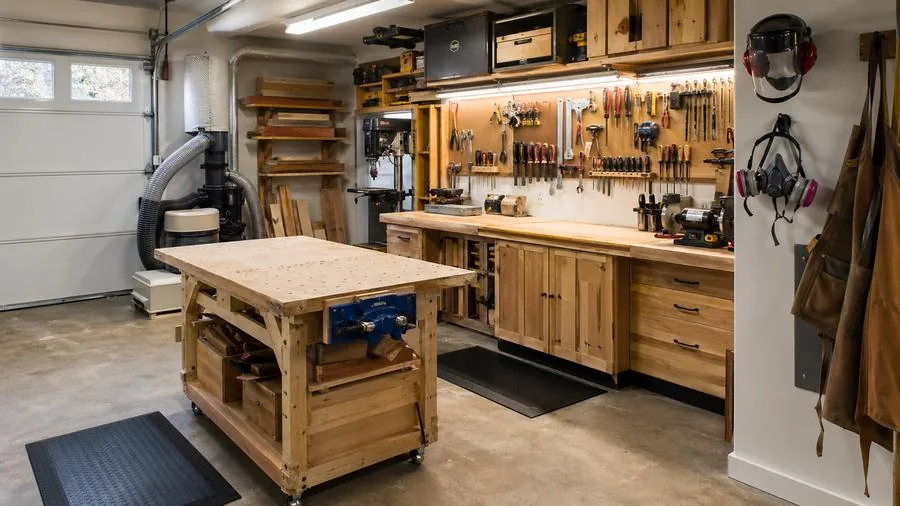
The single car garage workshop is one of the most popular, and most misunderstood, setups in DIY woodworking. Many people assume a small space means making constant compromises. In reality, with the right layout strategy, a 10×20 foot garage bay can be a fully capable, productive woodworking space that handles furniture, cabinetry, and even large outdoor projects.
Reader Note: This article contains affiliate links. If you choose to purchase through one, we may earn a small commission at no extra cost to you. We only recommend products we genuinely stand behind. Full disclosure here.
The Fundamental Rule of Small Workshop Design
Every square foot of floor space in a small workshop is premium real estate, but the real limitation isn't the floor, it's your infeed and outfeed space. A table saw needs 8 feet of clearance in front and behind to handle full sheets of plywood. A workbench needs at least 3 feet of clear space on three sides for comfortable working. Design your workshop around these clearance requirements first, and everything else follows from there.
🔧 Projects Sized for Small Workshops
Ted's Woodworking includes 16,000 plans across all skill levels, many specifically designed for builders working in small garage workshops with limited tool sets. Find projects that fit your space and tools perfectly.
Browse Plans for Small Workshops →The 4 Small Garage Workshop Layout Strategies
Strategy 1: The One Wall Layout (Best for Very Small Spaces)
Place your workbench and all wall mounted tool storage along a single wall. Keep the remainder of the floor completely clear. This layout works in spaces as small as 8×10 feet and allows you to work on long pieces by directing them diagonally across the open floor space. Tools not in use are stored on wall mounts and brought to the workbench as needed. The limitation is that you can only run one process at a time, but for most solo woodworkers, this isn't a real constraint.
Strategy 2: The L Shape Layout (Best for Single Car Garages)
Run your primary workbench along one wall, then add a secondary assembly table or tool stand along the adjacent wall, creating an L. This gives you two separate work zones, one for precision bench work and one for assembly or power tool use, while keeping the central floor clear. This is the most versatile layout for a single car garage and can accommodate dedicated stations for a drill press, band saw, or scroll saw on the secondary arm of the L.
Strategy 3: The Mobile Tool Strategy (Best for Shared Garages)
If your garage serves multiple purposes, parking, storage, gym, mobile tool bases are the solution. Every power tool goes on a wheeled base that locks in position during use and rolls against the wall when not in use. Combine this with a folding workbench (a solid Workmate style bench or a DIY folding bench wall mount) that drops flat against the wall when the car needs to come in. This approach requires more setup time per session but gives you genuine dual use flexibility.
Strategy 4: The Station System (Best for Production Work)
Arrange tools in workflow order around the perimeter of the garage: timber storage → rough cutting station → joinery station → assembly table → finishing station. Each station is sized exactly for its purpose and positioned to minimise material handling distance. This system works best if you build similar projects repeatedly, it's the foundation of a home woodworking production workflow and the most efficient use of a dedicated garage space.
Maximising Vertical Space: The Storage Multiplier
In a small workshop, unused wall space above eye level is wasted money. A full wall of floor to ceiling storage can multiply your effective storage space by 3,4× compared to bench height storage only. Build simple wall cabinets from plywood above the workbench for dust free finishing product storage. Install horizontal lumber rack arms directly into wall studs at ceiling height for timber storage that keeps the floor clear. Use a french cleat system (strips of angled plywood at 45°) along the primary wall for infinitely rearrangeable tool storage.
💡 Vertical Storage Tip: Store timber horizontally at ceiling height on purpose built arms. In a typical garage with 8 foot ceilings, you can store 8 foot boards horizontally on ceiling level arms with still 6+ feet of clearance below, enough to work comfortably while your stock stays perfectly dry and organised above.
Dust Control in a Small Garage Workshop
Dust management is more critical in a small space because there's less air volume to dilute sawdust, and every tool is closer to your breathing zone. The minimum requirement for a small garage workshop is a shop vacuum connected to each tool during use and a dedicated air filtration unit hung from the ceiling. A ceiling mounted ambient air filter ($80,120) continuously cleans workshop air between uses, dramatically improving both air quality and visibility.
For the workbench itself, a simple downdraft table, a box with holes drilled through the top connected to your shop vacuum, contains sanding and routing dust at the source. This is an excellent first workshop project: it costs under $30 in materials, takes 2,3 hours to build, and immediately improves your workshop environment.
Lighting: The Most Underrated Workshop Upgrade
Poor lighting in a workshop causes measurement errors, poor finish quality, and safety risks. A small garage workshop needs at least 50 foot candles of general illumination plus task lighting above the workbench. Two rows of LED shop lights (4000K colour temperature for accurate colour rendering during finishing) provide adequate general illumination in a single car garage for around $80 total. Add a positionable LED strip or work light above the bench for detail work, this is the single most impactful improvement most small workshops can make.
Temperature and Ventilation
Wood moves with humidity. A workshop that gets extremely hot or cold, typical of uninsulated garages, will cause problems: glue failures in cold weather, wood movement in dry summers, and condensation issues that affect timber quality. A basic garage workshop doesn't need year round climate control, but insulating the walls and ceiling (affordable with batts of fibreglass insulation) significantly extends your comfortable working season and stabilises the humidity that affects your timber.
Ventilation is also a safety requirement, not just a comfort one. Finishing products produce flammable vapours that must be exhausted from the space. A through wall exhaust fan ($35,60) positioned near floor level (where vapours settle) provides adequate ventilation for occasional finishing work in a garage workshop.
The Compact Tool List for a Garage Workshop
The most productive small garage workshops avoid large, space hungry stationary tools and instead rely on high quality portable and benchtop alternatives. A track saw replaces a table saw for most cutting operations while using zero floor space when stored. A compact benchtop band saw handles curved cuts without a full floor standing machine. A portable planer fits under a bench. These compact alternatives produce results indistinguishable from their full size equivalents for 90% of projects, at a fraction of the footprint.
🚀 Your Workshop Is Ready. Now Build Something Great.
Access 16,000 woodworking plans designed for every skill level and tool set. Find the perfect project for your new garage workshop, then build it this weekend.
Find Your Perfect Project Plan →