Every beginning woodworker faces the same overwhelming moment: the tool aisle. Hundreds of tools, dozens of brands, and no clear path through. The truth is you need far fewer tools to start than you think. This list covers the 15 tools that will handle 95% of beginner projects, and explains exactly what to buy, what to borrow, and what to skip entirely until you're further along.
Reader Note: This article contains affiliate links. If you choose to purchase through one, we may earn a small commission at no extra cost to you. We only recommend products we genuinely stand behind. Full disclosure here.
The Non Negotiable Measuring Tools
A tape measure (25 foot, with a wide blade that stays stiff when extended), a combination square (for marking 90° and 45° angles precisely), and a marking knife or sharp pencil. Accurate layout is the foundation of accurate work. Every dimension error that causes problems later starts at the marking stage. Don't skip the combination square, a protractor and ruler combo doesn't replace it.
⚠️ Quality Tip: Buy a Starrett or Empire combination square. Cheap squares are often not truly square, which makes them actively harmful rather than just useless.
📐 Great Plans for Your New Tools
Once you have your basic toolkit, you need projects that actually use it. Ted's Woodworking has over 16,000 plans designed for every skill and tool level.
Browse Plans →Hand Saws and Their Uses
A good hand saw is faster and quieter than a power saw for small cuts and cross cuts in thin material. Buy a Japanese pull saw (it cuts on the pull stroke, requiring less effort and producing a finer kerf) rather than a traditional push saw for your first saw. A decent pull saw costs $15,$30 and outperforms much pricier traditional saws for typical beginner work.
You'll eventually want a crosscut saw and a rip saw, but start with one good Japanese pull saw and learn its limits before adding more.
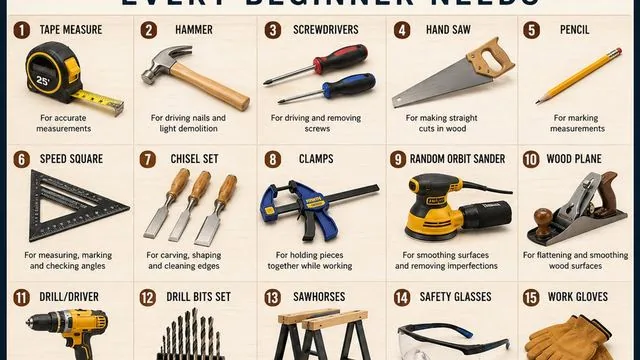
The 15 Essential Beginner Tools
- Tape measure, 25 ft / 8m with stiff blade
- Combination square, 12 inch, quality brand
- Japanese pull saw, fine and coarse teeth
- Chisels, set of 4 (1/4", 1/2", 3/4", 1")
- Mallet, wooden or rubber, for driving chisels
- Hand plane, No. 4 smoothing plane
- Cordless drill/driver, 18V with two batteries
- Drill bit set, HSS, 1,10mm plus countersink
- Random orbit sander, 125mm / 5 inch
- Sandpaper assortment, 80, 120, 180, 240 grit
- Clamps, minimum 4 × F clamps, various sizes
- Workbench or work surface, even a solid table works
- Safety glasses, always, no exceptions
- Hearing protection, for any power tool use
- Dust mask, P2/N95 minimum for sanding
The One Power Tool Worth Buying Early
If you're going to buy one power tool, make it a random orbit sander. It does the finishing work that makes the difference between an amateur looking result and a professional one, it's inexpensive, and it's nearly impossible to use incorrectly. A corded 5 inch model from a reputable brand costs $40,$70 and will last years.
After your sander, the next power tool priority is a circular saw (for breaking down sheet goods and making long rip cuts) followed by a jigsaw (for curves). A power drill/driver is essential from day one, borrow one if you can't buy immediately.
What to Skip for Now
Table saws, routers, planers, and jointers are all genuinely useful but entirely unnecessary for your first 12,18 months of woodworking. A table saw requires a dedicated, clear space and carries real risk for inexperienced operators. A router is a versatile but complex tool that rewards practice. Skip these until you've developed solid hand and basic power tool skills, your work quality won't suffer without them.
🪚 Ready to Put Those Tools to Work?
Get 16,000+ woodworking plans designed to build real skills, from your first cutting board to fully fitted furniture. Every plan includes a complete materials list.
Browse All Plans →