YouTube has billions of woodworking videos. Yet the comment sections of woodworking forums are filled with people who have watched hundreds of hours of videos and still can't confidently build a bookcase. There's a reason for that, and understanding it could be the most important thing you do before your next project.
Reader Note: This article contains affiliate links. If you choose to purchase through one, we may earn a small commission at no extra cost to you. We only recommend products we genuinely stand behind. Full disclosure here.
The Problem with Learning Woodworking from YouTube Alone
YouTube tutorials are designed to be entertaining first and educational second. A 15 minute video about building a bookcase will show you the most visually interesting moments, the dramatic glue ups, the satisfying sanding, the final reveal, but will compress or skip the foundational steps that are actually hardest for beginners: layout accuracy, troubleshooting tearout, correcting out of square assemblies.
The result? You watch, you feel confident, you start building, and you hit a problem the video didn't cover. You spend an hour searching for another video, lose your momentum, and either make a costly guess or abandon the project. Sound familiar?
📐 Plans That Replace 1,000 YouTube Videos
Ted's Woodworking gives you 16,000 complete, tested plans with everything you need in one place, cut lists, step by step sequences, material guides, and diagrams. No searching, no guessing, no wasted timber.
Get 16,000 Complete Plans →YouTube's Strengths (And How to Use Them Properly)
To be fair, YouTube excels at specific woodworking learning tasks. Watching a technique demonstrated, hand tool sharpening, router setup, hand cutting dovetails, is often far more effective than reading about it. Visual, hands on techniques that are hard to describe in text genuinely belong on video. The issue is using YouTube as a primary project guide rather than a technique reference.
The best approach is to use YouTube for technique study and digital plans for project execution. Watch a video on how to cut a mortise, then return to your written plan to know exactly where and what size each mortise in your project needs to be.
What YouTube Does Well
Visual technique demonstration is where video genuinely excels. Watching someone sharpen a chisel, set up a router table, or adjust a hand plane gives you information that words and still images simply cannot convey. YouTube also excels at inspiration, seeing what's achievable in a weekend, or what furniture styles are possible with basic tools, is deeply motivating. Use it for this.
Where YouTube Falls Short for Builders
YouTube fails when you need precision. No video will pause while you measure. Dimensions are often shown briefly in the corner of the screen, requiring you to rewind repeatedly. Cut lists either aren't given, or are mentioned briefly in a description box. Most critically, the build sequences shown in videos are optimised for filming, not for building, a good cinematographer and a good woodworker make different choices about what order to work in.
💡 Research Insight: Studies in skill acquisition consistently show that practice with clear, measurable goals produces faster improvement than passive observation. Watching someone else build doesn't train your hands, building does. Plans give you the framework to build; videos show you how specific techniques look.
What Digital Plan Libraries Do Better
Complete Information in One Place
A complete digital plan gives you everything needed before you make a single cut: the full materials list, every dimension, the assembly sequence, and finishing instructions. There's no pausing, rewinding, or hunting for the description box. When you're standing at the bench with a piece of timber in your hands, this completeness is invaluable.
Reference at Any Point in the Build
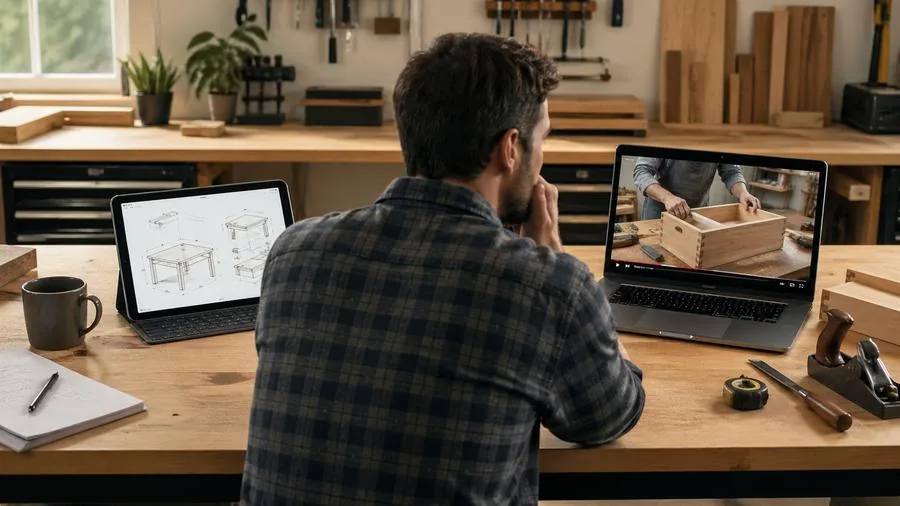
Plans are reference documents, you can jump forward to check how pieces connect, revisit the cut list when you make a mistake, or check a dimension three times without losing your place. A video requires either perfect memory or constant rewinding. On a tablet in the workshop, a good digital plan is as accessible as a video but far more useful as a reference.
Consistency Across Projects
When plans come from a single curated library, the format is consistent. You always know where to find the cut list, what the skill ratings mean, and how the step numbering works. This reduces cognitive load as you build, you spend mental energy on the woodworking, not on decoding a new format every time.
Freedom to Choose Your Next Project
With a comprehensive plan library, your next project is determined entirely by what you want to build, not by what YouTube algorithm recommends, and not by whether someone happened to make a video about it. This is enormous creative freedom. Want to build a specific style of Japanese tansu chest? There's a plan. A dog kennel that matches your back fence? There's a plan. A workbench optimised for handtools? Multiple plans, different sizes and configurations.
🗂 Every Project You'll Ever Want to Build
16,000 plans covering furniture, garden projects, workshop storage, toys, décor, outdoor structures and more. Every plan includes cut list, materials guide, step by step instructions, and detailed diagrams. One library, a lifetime of projects.
Explore the Full Plan Library →The Hybrid Approach: Why Serious Woodworkers Use Both
The most effective woodworking learners use digital plans as their project backbone and YouTube as their technique dictionary. When they encounter a technique they haven't attempted before, say, cutting a bridle joint or setting up a dado stack, they watch a few YouTube demonstrations of that specific technique, then return to their plan and execute it with the precision the plan provides.
This approach avoids the two most common failure modes: wandering through YouTube without building anything, and building from a plan without the visual technique reference that makes difficult joints achievable for beginners.
Comparing the True Cost
YouTube appears free, but consider the real cost: hours searching for relevant videos, timber wasted on projects built from incomplete instructions, and the opportunity cost of slow skill development. A comprehensive plan library that costs less than a bag of quality timber, and saves even a single mis cut board per project, has paid for itself within the first build. Across hundreds of projects, a good plan library is the cheapest tool in your workshop.
Our Verdict
YouTube is a brilliant technique reference and inspiration tool. Digital plan libraries are the foundation for actually building great projects. Use them together: search a plan library first to find your project, then use YouTube to fill in technique gaps as they arise. This combination is how beginners progress to intermediate skill in months rather than years, and how experienced woodworkers continue to improve without expensive courses.
🚀 Start Building with Complete Plans Today
Access 16,000 tested, professionally written woodworking plans. Never waste a weekend on an incomplete free plan again. Your next project, your best project, starts here.
Get Instant Access to 16,000 Plans →